How much of your Amazon PPC budget is spent competing against your own campaigns?
For brands managing Sponsored Products, Sponsored Brands, and Sponsored Display through separate teams, budgets, and KPIs, siloed optimization can create hidden inefficiencies. Campaign cannibalization, overlapping bids, fragmented attribution, and disconnected funnel strategies can drive up ad costs without being obvious in individual campaign reports.
The problem is that Amazon Ads reporting largely evaluates each ad type separately, making it difficult to see how campaigns interact across the account. Understanding these cross-format inefficiencies is essential to controlling advertising costs and protecting profit margins.
How Siloed Amazon Sponsored Ad Campaigns Form and How Sellers Can Detect Them
Siloed structures typically develop as an Amazon PPC advertising account scales. As Sponsored Products, Sponsored Brands, and Sponsored Display campaigns expand, sellers may begin optimizing each format independently based on its own objectives, reporting dashboards, and performance indicators. Under this model, each campaign type often prioritizes the metrics most relevant to its assigned advertising format:
- Sponsored Product Ads: ACOS, conversion rate, CPC, search term efficiency, placement performance, and impression share at the keyword and ASIN level.
- Sponsored Brand Ads: Top-of-search impression share, new-to-brand orders, branded keyword defense, category discovery, and Store page engagement.
- Sponsored Display Ads: Viewable impressions, detail page view rate, audience reach, retargeting performance, and engagement metrics.
These metrics are valid within their respective formats. Margin erosion occurs when no one reconciles the three against total sales, TACoS, and contribution margin per ASIN. When each campaign type is evaluated through its own performance lens, this loss rarely triggers a single alert. The impact surfaces as a set of warning signs across standard Amazon Ads reports:
The Key Causes Behind Siloed Amazon PPC Campaign Management
1. Different Campaign Objectives Create Separate Optimization Paths
Sponsored Products are often treated as a direct-response channel focused on capturing high-intent shoppers and driving conversions, while Sponsored Brands and Sponsored Display are often evaluated for brand discovery, visibility, and retargeting impact. Because each format has different reporting dashboards and KPIs, sellers may evaluate them independently rather than measuring their combined contribution to the customer journey.
2. Lack of ASIN-Level Advertising Strategy
Many sellers manage campaigns by ad format rather than by product lifecycle and profitability goals. For example:
- New ASINs: May need awareness and conversion support through a combination of Sponsored Brands, Sponsored Display, and Sponsored Products.
- Mature ASINs: May require efficiency-focused campaigns to maintain profitable conversions.
- High-margin ASINs: May justify higher acquisition costs when the potential return supports additional investment.
Without an ASIN-level advertising strategy, different ad formats can compete for the same shoppers without a clearly defined role within the conversion journey.
3. Short-Term Performance Goals Override Portfolio-Level Optimization
Sponsored Products may be optimized toward ACOS targets, while Sponsored Brands may be protected for visibility goals such as impression share or brand discovery. Without a shared profitability framework, campaigns can appear successful individually while reducing total advertising efficiency.
A campaign may achieve its assigned KPI while still limiting the overall effectiveness of the advertising portfolio when evaluated against TACoS, contribution margin, and incremental conversions.
How Amazon Sellers Can Detect Siloed PPC Structures
- Rising CPC on Branded Terms: Branded CPC increases while competitor activity on those terms remains flat, indicating that the brand’s own campaigns or accounts are competing for the same traffic.
- Unmanaged Search Term Overlap: The same high-value queries receive spend across multiple campaign types, with no defined role for each campaign.
- Falling New-to-Brand Share: New-to-brand conversions decline after the reduction of Sponsored Brands or Sponsored Display ad budget, even when Sponsored Products ACOS remains stable.
- Overlapping Attributed Signals: Multiple campaigns receive credit for influencing the same customer journey because Amazon attribution windows allow different ad formats to capture conversion influence. This can make channel-level performance look stronger than the incremental impact each campaign generates.
- Declining Retargeting CTR: Click-through rate on Sponsored Display retargeting audiences drops as impressions rise, indicating ad repetition to the same shoppers.
How Siloed Amazon PPC Campaigns Undermine Advertising Efficiency
1. Campaign Cannibalization
Campaign cannibalization occurs when multiple ad campaigns target the same search terms or shoppers without a shared ownership plan. It takes four forms:
- Internal Keyword Competition: Multiple campaigns within the same account compete for the same search terms, splitting impressions and clicks across campaigns. This fragments performance data and makes bid optimization less reliable.
- Multi-Account Bidding Wars: Brands that advertise through both vendor (1P) and seller (3P) accounts can enter the same auctions as two separate advertisers. This overlap raises CPC on branded and category terms and produces the branded CPC increase described above.
- Cross-Format Overlap: Sponsored Products and Sponsored Brands campaigns targeting the same high-intent term occupy two placements on one search results page, with no defined owner for the query.
- Retargeting Overlap: Sponsored Display views and purchases remarketing audiences often include shoppers already reached through Sponsored Brands video. Separately defined audiences and lookback windows lead to repeated ad exposure and declining click-through rate.
In a typical scenario, a supplements brand bids on “magnesium glycinate 400mg” through both an exact-match Sponsored Products campaign and a Sponsored Brands headline campaign. Dual placement can be a deliberate strategy to protect a hero ASIN or increase visibility. However, it becomes inefficient when the additional placement captures clicks that would likely have converted through another campaign at a lower cost.
2. Disconnected Funnel Attribution
Amazon Ads reports conversions for each ad type under a last-touch model with its own attribution window. Sponsored Products uses a 7-day click window for sellers, Sponsored Brands and Sponsored Display use 14-day windows, and Sponsored Display can also credit ad views. This reporting structure creates three blind spots:
- Last-Touch Credit Allocation: Last-touch attribution assigns conversion credit to the ad interaction closest to purchase. For example, when a shopper discovers a product through Sponsored Brands or Sponsored Display but later converts after clicking a Sponsored Products ad, Sponsored Products receives the attributed sale while the earlier interactions receive no conversion credit. This can make lower-funnel campaigns appear more efficient and cause upper-funnel campaigns to appear less effective.
- Overlapping Attribution Windows: Different attribution windows and attribution models across ad formats can make the same customer journey appear across multiple reports. When sellers combine these figures without accounting for overlap, they can overstate total attributed sales and ROAS.
- Isolated Audience Signals: Engagement data from Sponsored Display and Sponsored Brands remains in separate reports, so lower-funnel campaigns never use it to refine bids or targeting.
3. Fragmented Budget Ownership
Budgets set once per quarter for each ad type rarely respond to demand. On a peak day, a Sponsored Products campaign can reach its daily cap while a Sponsored Display campaign underspends. The resulting loss in sales velocity weakens organic ranking for the affected ASINs.
The Comparison: Siloed vs. Unified Amazon PPC Management
| Attribute | Siloed Campaign Management | Unified Campaign Management |
| Primary KPI | ACOS per ad type, reviewed in isolation | TACoS, contribution margin per ASIN, and incremental growth impact |
| Keyword ownership | Search terms duplicated across campaigns, formats, and accounts | Search terms have defined strategic roles across campaigns, formats, and funnel stages |
| Attribution model | Last-touch reporting summed across three dashboards | Multi-touch attribution with deduplicated conversions |
| Budget control | Budgets allocated independently by ad type or team | Budgets adjusted based on ASIN profitability, campaign role, and customer stage |
| Retargeting | Audiences and lookback windows defined by each team | Shared audience definitions across formats |
| Risk factor | Inflated CPC, premature pausing of upper-funnel campaigns, overstated ROAS | Slower initial setup and a dependency on cross-team review |
How Multi-Touch Attribution Provides a More Complete View of Each Ad Type’s Contribution
Amazon Ads introduced a multi-touch attribution model (beta) at unBoxed 2024, allowing eligible advertisers to analyze how multiple ad interactions contribute to conversions. The model distributes purchase credit across Amazon Ads touchpoints in proportion to their estimated contribution, using machine learning and historical shopping signals. It covers Sponsored Products, Sponsored Brands, Sponsored Display, Sponsored TV, and Amazon DSP. Multi-touch orders, sales, and ROAS appear in the advertising console, reports, and API.
Source: Amazon
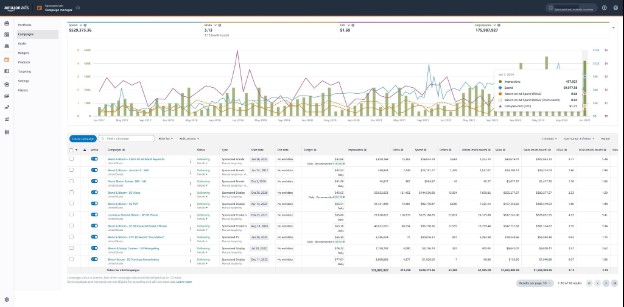
For a siloed account, the multi-touch attribution model corrects three reporting gaps:
- Halo Value Visibility: Sponsored Brands and Sponsored Display receive partial credit for the orders they influenced, so teams can evaluate them before pausing.
- Fair Format Comparison: Teams assess ad types on multi-touch ROAS instead of last-touch ACOS.
- Deduplicated Conversions: Credit for each order is split across touchpoints, so blended ROAS reconciles with actual sales.
To leverage these insights, compare each format’s share of multi-touch sales with its share of last-touch sales. A format with a significantly higher multi-touch share contributes more than its standard report shows and warrants budget protection.
Beyond attribution measurement, Amazon has also been moving toward more integrated campaign management workflows. At unBoxed 2025, Amazon Ads announced a unified campaign manager and full-funnel campaigns that manage budgets across Sponsored Products, Sponsored Brands, display, and streaming TV. Amazon also reported that advertisers using Ads Agent achieved 8% lower cost per impression and 6% lower cost per acquisition.
The Framework: How to Unify Amazon Sponsored Ad Campaigns Under One PPC Strategy
Step 1: Set Account-Level and Full-Funnel KPIs
- Account-Level KPIs: Adopt TACoS and contribution margin per ASIN as the shared targets for all three ad types.
- Ad Type KPIs: Evaluate Sponsored Brands and Sponsored Display on new-to-brand rate, branded search volume, and multi-touch ROAS rather than last-touch ACOS.
Step 2: Align Campaign Strategy with Search Intent
Align ad types with each ASIN’s lifecycle stage and sales velocity:
- Hero ASINs: Prioritize Sponsored Products on proven converting terms while maintaining discovery campaigns where incremental growth opportunities exist. Support them with Sponsored Brands on branded keywords and Sponsored Display brand defense campaigns that protect product detail page placements from competitor ads.
- New Launch ASINs: Use Sponsored Products auto and broad match for keyword discovery. Consider Sponsored Brands video and Sponsored Display product targeting where awareness-building or competitor conquesting aligns with launch objectives.
- Long-Tail ASINs: Limit spend to Sponsored Products on high-relevance, low-competition keywords to protect ACOS.
Step 3: Enforce Keyword Isolation and Hybrid 1P/3P Account Alignment
- Keyword Isolation: Assign each high-value search term to one campaign and ad type, and apply negative exact match keywords to prevent cross-campaign overlap.
- Hybrid 1P/3P Account Alignment: When vendor and seller accounts advertise the same brand, assign branded keywords to one account or align bids between them.
Step 4: Align Audiences and Budgets
- Audience Alignment: Standardize retargeting audiences and lookback windows across ad types so Sponsored Display extends reach rather than duplicating exposure.
- Portfolio Budget Caps: Group campaigns into portfolios with a monthly budget cap, and rebalance spend in a weekly review of TACoS, organic rank, and in-stock rate.
Note: Reduce Sponsored Brands and Sponsored Display spend on ASINs with low weeks of cover. Ads stop serving once an ASIN loses the Featured Offer.
Step 5: Measure Incrementality
Compare ad types on multi-touch orders and ROAS, then validate the results with Amazon Marketing Cloud (AMC) path-to-conversion analysis before reallocating budget.
The Path Forward: Unifying Amazon PPC Campaigns for Better Budget Control
A unified Amazon PPC strategy turns three competing cost centers into one margin-controlled growth channel. Consolidated management lowers cost per click on priority keywords and bases budget decisions on each ad type’s measured contribution. It also protects the upper-funnel demand that drives Sponsored Products conversions and organic ranking.
Three principles anchor this strategy:
- Account structure directly affects advertising cost. Duplicate keywords and uncoordinated retargeting raise cost per order. Competing vendor and seller accounts raise CPC on branded keywords.
- Last-touch reporting understates upper-funnel value. Multi-touch attribution identifies which ad types build demand that Sponsored Products later converts.
- Structured governance protects margin. Shared KPIs, keyword isolation, and portfolio-level budget reviews give advertisers consistent control across all three ad types.
A unified Amazon PPC campaign management approach ultimately moves beyond campaign-level optimization to portfolio-level decision-making. When Sponsored Products, Sponsored Brands, and Sponsored Display operate in silos, sellers lose visibility into how each format contributes to the customer journey, create unnecessary campaign overlap, and make budget decisions based on incomplete performance signals. As advertising costs increase and customer journeys become more complex, sellers need to evaluate each ad format’s role in discovery, consideration, and conversion. Coordinating these campaigns under a shared strategy reduces internal inefficiencies, improves budget allocation, and builds a PPC structure aligned with long-term profitability.
Author Bio: Ravi Kant is the Vice President of the eCommerce and Photo Editing Division at SunTec India. With over two decades of global experience, he spearheads large-scale digital commerce initiatives that drive operational excellence and measurable ROI for global



0 Comments